
Table of Contents
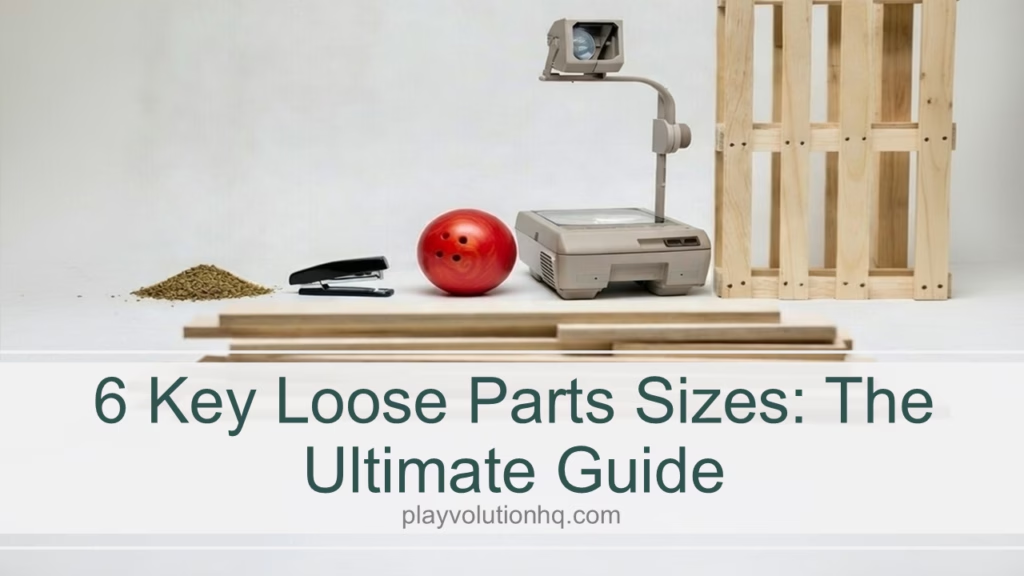
I put together this post on loose part sizes as a practical evaluation tool for early learning settings to check if their loose parts collections cover the full range. Different sizes promote different play and learning experiences. In my 30-plus years of observing programs, too many tend to limit their offerings to small and medium items. There are logical reasons for those limits that I’ll touch on below, but I hope that by the end, you’ll embrace the logic of offering options in all sizes.
Tiny Loose Parts
I’ll define tiny loose parts as chokables and near-chokables—items that fall through (or nearly fit through) a choke tester (affiliate link) or toilet paper tube. You’ll find examples here: Tiny Loose Parts Ideas.
It’s logical for early learning settings to avoid these small bits and pieces because of the potential hazard. Young children do benefit from manipulating items in this size range, though—it helps hone small muscle skills, visual tracking, and more. Here are some key ways tiny loose parts support young children’s development:
- Strengthens pincer grasp and hand-eye coordination—Picking up, placing, and releasing tiny items builds the precise thumb-index pinch needed for later skills like buttoning clothes, holding a pencil, or self-feeding.
- Builds focus, concentration, and attention to detail—The small scale demands careful, sustained movements and noticing subtle differences.
- Enhances tactile sensory exploration and discrimination—Varied tiny textures sharpen the sense of touch and help refine perceptual skills through hands-on discovery.
While avoidance of tiny loose parts often feels like the safest choice, they can be used thoughtfully with hazard mitigation in place: offering them only to children who no longer mouth objects, ensuring everything is picked up afterward, limiting use to certain areas, and providing close adult supervision.
In my family child care days, we let one-year-olds explore tiny loose parts while sitting on an attentive adult’s lap. It gave them that hands-on opportunity safely.

Small Loose Parts
Let’s define small loose parts as non-chokeables up to about softball size. Examples here: Small Loose Parts Ideas. This is probably the dominant size of loose parts in most early learning settings. Items of this size are readily available and incredibly versatile. Their compact size also makes them a good choice for programs with limited activity and storage space.
Medium Loose Parts
Medium loose parts range from about softball-sized to basketball-sized. Here are some examples: Medium Loose Parts Ideas.
Like small loose parts, those in this category are already fairly popular in early learning settings. They invite lots of play and exploration and are easy to source. They do, however, require more activity and storage space than their smaller counterparts.
Large Loose Parts
Other reasons I hear for omitting them include longer cleanup times due to their size and vague safety concerns—bigger just seems more hazardous, I suppose.
As a counterpoint, here are some key reasons these bigger items are so beneficial:
- Promotes physical development—Children lift, push, pull, carry, climb on, crawl through, or roll heavy/large items, building overall strength, balance, coordination, endurance, and body awareness through resistive, deep-pressure feedback that lighter small or medium pieces can’t match.
- Enables large-scale STEM play—Kids build big structures (forts, ramps, bridges, enclosures, dens) that require planning, testing stability, awareness of material properties, and problem-solving at a level small/medium constructions don’t reach—sparking deeper understanding across STEM areas.
- Supports expansive dramatic play scenarios—After building structures, children play in and around them, sparking complex, immersive pretend play and storytelling that goes far beyond the Small World play possible with smaller items.
- Fosters collaboration—The very properties that make large loose parts less common encourage kids to work together—leading to communication, turn-taking, compromise, and joint decision-making that small/medium loose parts rarely require (solo or small-pair play is more typical with smaller pieces).
- Builds confidence—Handling larger, heavier pieces lets children test physical limits, experience big successes (or safe failures) after effort, practice real-time risk assessment, and develop persistence and drive. Smaller, lighter items aren’t as challenging—and young children thrive on appropriate challenges.
Including large loose parts—even just a few items outdoors or in a dedicated zone—helps complete the full range and unlocks play experiences that small and medium alone can’t provide.
Jumbo Loose Parts
Here’s your draft with minimal smoothing for rhythm, clarity, and flow—keeps your wording and intent intact:
Jumbo loose parts are those bigger than a car tire. Another way to visualize the difference between large and jumbo is that most large loose parts can be moved with effort by a solitary child, while jumbo loose parts always require two or more. Examples here: Jumbo Loose Parts Ideas.
Jumbo loose parts offer all the learning benefits of large loose parts—only on an even bigger scale.
Another key thing about jumbo loose parts is that many are immobile—think slides, trees, or large fixed structures. That’s right: according to Simon Nicholson, author of “The Theory of Loose Parts,” “loose” refers to the various ways an item can be used and interacted with, not necessarily its mobility. In an early learning setting, a slide becomes a loose part when adults allow (and encourage) children to engage with it in multiple, open-ended ways—climbing, sliding, building around it, or repurposing it in play.

Mixed-Size Loose Part
The last of our six loose parts categories is mixed-size. Many loose parts items ( pine cones and rocks, for example) naturally span two or more of the size ranges we’ve covered—so we’ll label them mixed-size loose parts. You’ll find examples here: Mixed-Size Loose Parts Ideas.
Rocks, for instance, might range from tiny pebbles in a sensory bin to a jumbo stationary boulder on the playground. Providing access to items across different sizes enhances play and exploration in meaningful ways. Sure, sticking to just shoebox-sized cardboard boxes can lead to lots of learning and fun. But playing with only one size isn’t as richly engaging as having the chance to explore boxes ranging from toothpick-sized to refrigerator-sized—mixing scales invites bigger builds, more complex pretend scenarios, natural comparisons, and collaborative play that single-size collections can’t match.
Sizeless Loose Parts
Before wrapping up this post, I want to point out that loose parts also come in a seventh category: those with no size at all. Many loose parts aren’t physical objects—they’re concepts like Fast and Cold, or phenomena like Wind and Static Electricity. (This aligns with Simon Nicholson’s original idea that loose parts include variables such as physical phenomena, sounds, motion, words, concepts, and ideas. You’ll find examples of these sizeless loose parts at these links: Examples Of Concepts As Loose Parts, Phenomena As Loose Parts.
Key Loose Parts Sizes Wrap-Up
There, we’ve covered the six loose parts sizes I mentioned in the title and tossed in a seventh as a parting gift.
As you use this post as your evaluation tool, take a moment to look around your space and note which size categories (and even sizeless elements) are well-represented and which are missing or underrepresented. Over the years, I’ve seen that most programs lean heavily on small and medium loose parts for good, practical reasons, but offering the full range—from tiny chokables (with careful mitigation) to jumbo and even sizeless phenomena—unlocks richer, more varied play and learning opportunities that simply aren’t possible when the collection stays limited.
The two key takeaways I’d leave you with: first, variety in loose part sizes matters because each range supports different kinds of experiences and development; and second, even small, realistic steps toward adding what’s missing can make a noticeable difference for the children in your care. Take what works for your setting, and feel free to share how it goes.
Contribute content to Playvolution HQ
Brought to you by Explorations Early Learning
Browse Trainings
Post Author

Jeff Johnson is an early learning trainer, podcaster, and author who founded Explorations Early Learning, Playvolution HQ, and Play Haven.
Leave a Reply