
Synopsis
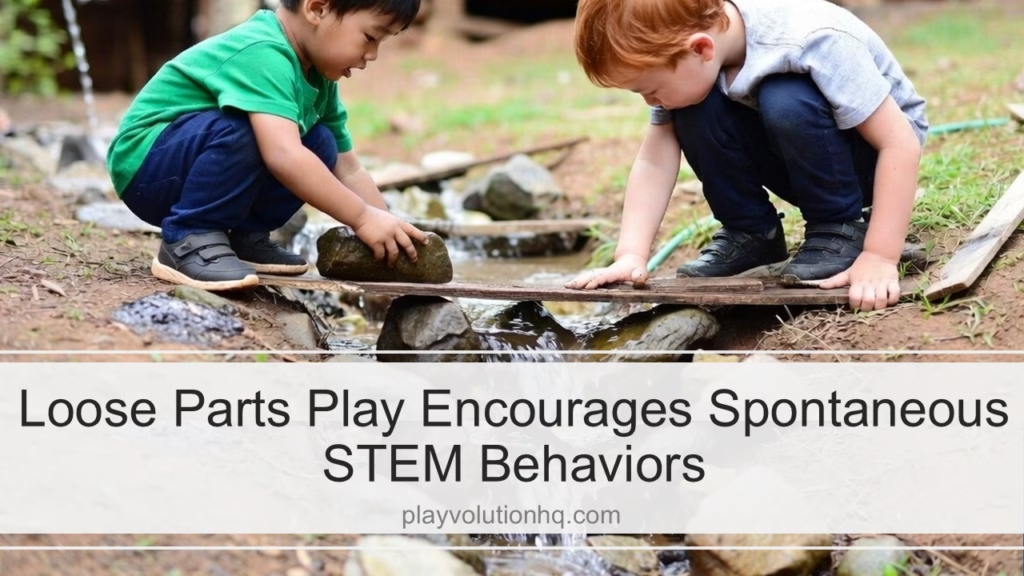
In this within-subjects experiment, 60 preschoolers (mean age 4 years 10 months) played alone for up to 30 minutes with either a diverse set of loose parts or toy percussion instruments (control). Researchers coded every minute of play for 11 specific STEM behaviours.
Key findings:
- Children displayed significantly more STEM behaviours with loose parts than with the control toys (large effect size).
- The most frequent behaviour was constructing structures, followed by explaining how things work, exploring mathematical concepts, and communicating goals.
- Overall STEM Engagement Score was dramatically higher with loose parts (median 1.3 vs. 0.2).
- Children spent more total time playing with loose parts.
- There were no differences by child sex.
- Children’s full-scale IQ strongly predicted how much STEM engagement they showed with loose parts.
- In the control condition, only verbal comprehension predicted engagement.
- Executive function and parents’ positive attitudes toward play predicted how often children built structures.
- Constructing structures was the dominant STEM behaviour and occurred far more often with loose parts.
Bottom line: Loose parts powerfully trigger spontaneous STEM behaviours during solitary play—especially building, explaining, and mathematical exploration—far more than limited-function toys. However, benefits are not automatic: children’s cognitive capacities and supportive home play environments shape how much they gain. This study gives strong experimental evidence that loose parts are an effective, everyday tool for early STEM learning, while highlighting the importance of considering individual differences.
Loose Parts Play Encourages Spontaneous STEM Behaviors
Here’s a PDF of the review:
Cankaya, O., Rohatyn-Martin, N., Buro, K. et al. Loose parts play encourages spontaneous science, technology, engineering, and mathematics (STEM) behaviours. Commun Psychol 3, 183 (2025). https://doi.org/10.1038/s44271-025-00362-y
Contribute content to Playvolution HQ
Brought to you by Explorations Early Learning
Browse Trainings
Post Author

Jeff Johnson is an early learning trainer, podcaster, and author who founded Explorations Early Learning, Playvolution HQ, and Play Haven.
Leave a Reply