
Revised | Originally Published: July 3, 2021 @ 4:28 pm
Overview
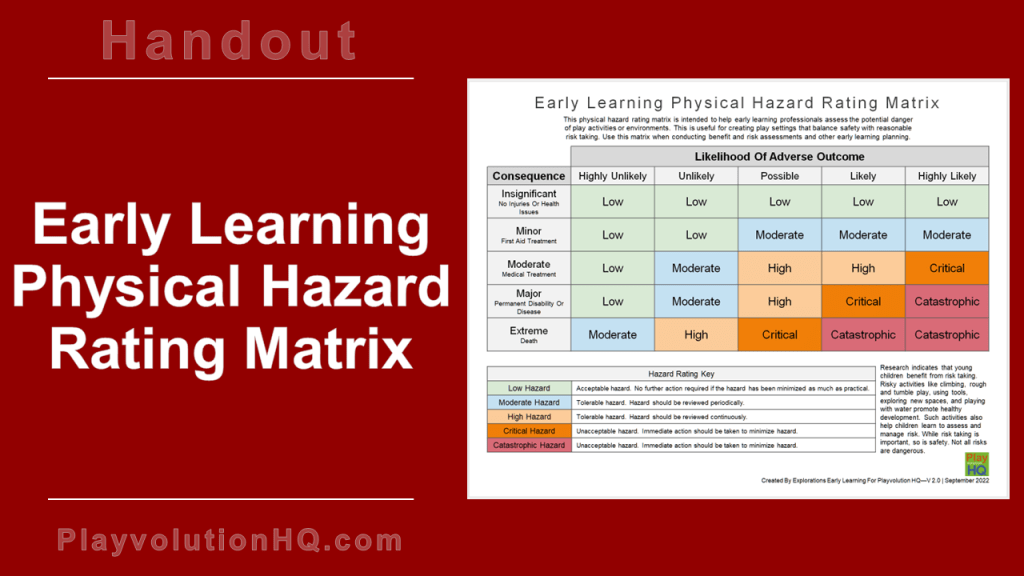
This free Early Learning Physical Hazard Rating Matrix is intended to help early learning professionals assess the hazards of play activities and environments in order to create settings that balance safety and reasonable risk taking. Use this matrix when conducting Benefit And Risk assessments and other early learning planning.
Research indicates that young children benefit from risk taking. Risky activities like climbing, rough and tumble play, using tools, exploring new spaces, and playing with water promote healthy development. Such activities also help children learn to assess and manage risk. While risk taking is important, so is safety. Not all risks are dangerous.
Using The Early Learning Physical Hazard Rating Matrix
To use the matrix, determine what the likelihood of an adverse outcome is for the activity you are considering based on the likely consequence. For example, the hazard rating for toddlers playing on a grassy lawn would be Highly Unlikely because, while falling is likely, the consequences for such a fall would be minimal. Try to be objective and avoid letting your personal bias taint your rating. Having multiple people in the program–or an outsider with fresh eyes–rate an activity can counterbalance individual subjectivity and give a more objective rating.
We recommend using the Early Learning Physical Hazard Rating Matrix with our Benefit And Risk Assessment.
Here’s The Free Early Learning Physical Hazard Rating Matrix Handout
Related Content

Post Author

Jeff Johnson is an early learning trainer, podcaster, and author who founded Explorations Early Learning, Playvolution HQ, and Play Haven.
Leave a Reply