
Table of Contents
Overview
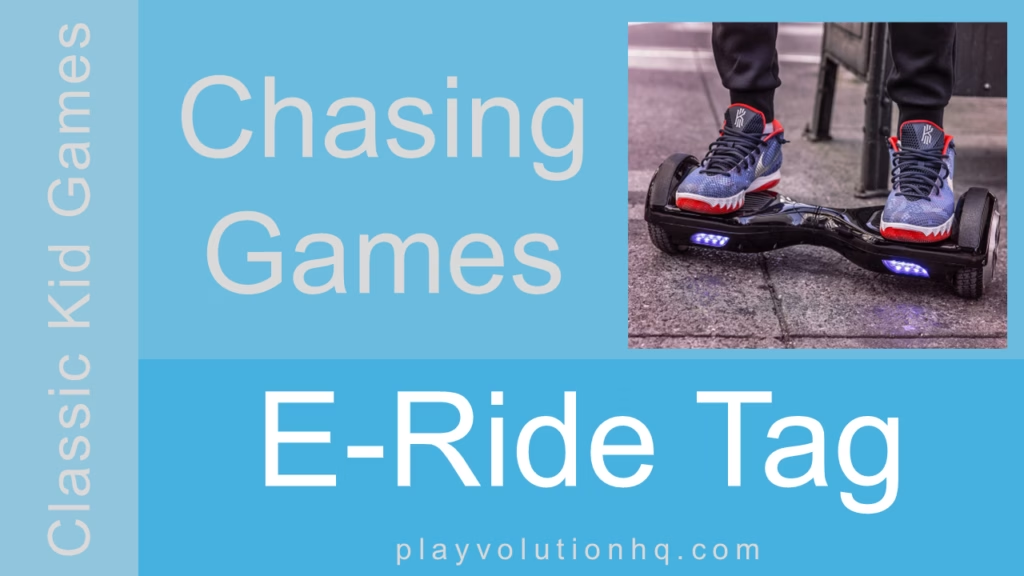
E-Ride Tag is the name I’ve given to the high-energy future classic kids game I’ve spotted neighborhood kids playing twice in the last week. It’s a thrilling modern twist on classic tag, where players zip around on electric bikes, scooters, or hoverboards, chasing and dodging with electric-powered speed and excitement.
If it’s popping up in my Gulf Coast neighborhood, it’s likely happening in backyards and parks across the country as these rides become everyday kid gear.
As an adult observer, I gave it some side-eye at first—yes, there are real hazards involved with speed, balance, and obstacles. But that caution was quickly overtaken by pure jealousy and a touch of rage: jealousy that I wasn’t out there joining in, and rage at being born a generation too early to have this kind of fun as a kid. Nine-year-old Jeff would have been all over this game.
How To Play
Here’s how to play:
- Gather Players—You’ll need at least three participants, but more adds to the chaos and enjoyment. Designate one player as “It,” who will chase the others on their electric rides. (About 10 kids were playing when I saw this new game in action.)
- Set Boundaries—Choose a safe, open area, such as a park, an empty parking lot, or a neighborhood street with low traffic. Agree on clear boundaries to prevent players from wandering too far or into unsafe zones. (The neighborhood kids were playing in an area that included a level grassy area and a portion of a parking lot with only a little traffic.)
- Start The Game—Everyone mounts their electric bike, scooter, or hoverboard. “It” counts to 10 while others scatter. The goal is for “It” to tag another player by touching them.
- Tag And Switch—Once tagged, that player becomes the new “It.” The game continues until everyone is tired or a time limit is reached.
Multimedia
E-ride tag is so new that there does not appear to be anything online that’s easily accessible. I thought about filming the play for this article, but the logistics of obtaining photo releases felt too daunting.
In place of actual multimedia, here’s an AI imagining of what the game looks like in real life.

Equipment
Electric bikes, scooters, or hoverboards (ensure they are charged and in good working condition). Safety gear: consider helmets, knee pads, elbow pads, and closed-toe shoes for all players (the kids I observed had none of these).
Tips
Here are tips for playing the game:
- Prioritize Safety—Wear protective gear and stick to low-speed modes on rides to avoid accidents.
- Ensure E-ride proficiency—All participants should handle their rides of choice with a modicum of proficiency.
- Choose The Right Terrain—Opt for smooth, flat surfaces to make maneuvering easier and reduce the risk of falls.
- Stay Aware—Keep an eye on surroundings, including pedestrians, cars, and obstacles, to ensure everyone has fun without mishaps.
History
E-Ride Tag appears to be a contemporary twist on traditional tag games, emerging from the growing popularity of electric personal rides among kids. No historical references or documented origins were found in online searches. It likely gained traction in recent years as e-bikes, scooters, and hoverboards became more accessible for recreational play.
I may have observed the first playing of e-ride tag in human history, but I doubt it. Still, it’s a recent development and a future classic kid game.
Variations And Related Games
Here are some additional E-ride games that have been evolving in my neighborhood:
- E-ride Follow-The-Leader—A parade of kid-driven electronic conveyance devices rolling, weaving, zigging, zagging, and zipping around.
- E-Ride Baseball—Picture a kid-organized baseball game where a couple of kids choose to bat and run the bases on their e-rides.
- E-ride Obstacle Course Challenges—This is evolving from the follow-the-leader game as kids test their skills at hopping curbs, navigating tight turns, and battle steep inclines.
Learning
E-Ride Tag fosters growth in the Physical Domain by enhancing coordination, balance, and motor skills through ride control and quick maneuvers. In the Social-Emotional Domain, it builds teamwork, resilience, and empathy as players navigate wins, losses, and fair play in a group setting. Cognitively, kids strategize evasion tactics and spatial awareness, promoting problem-solving under pressure.
E-Ride Tag Wrap-Up
As a final note, I found it interesting that I observed this game about 2 weeks after Christmas morning 2025. Just enough time for kids who got new rides from Santa to get comfortable on them and start looking for challenges beyond zipping up and down the sidewalk. Human children like to challenge themselves—and each other. In that context, e-ride tag seems a perfectly natural evolution of the game.
E-Ride Tag brings a fresh, electrifying spin to a timeless kid game. If you’ve witnessed or played this game, I’d love to hear about it in the comments. I’d also love to add some real photos or video of gameplay to this post.
Have a game or game variation I should add to the catalog, or a fun story from your own playtime? Scroll to the bottom of this page and drop it in the comments or contact me—I’d love to hear from you and keep growing this collection. If you like the post, share it; that’s always appreciated!
Contribute content to Playvolution HQ
Brought to you by Explorations Early Learning
Browse Trainings

Post Author

Jeff Johnson is an early learning trainer, podcaster, and author who founded Explorations Early Learning, Playvolution HQ, and Play Haven.
Leave a Reply