
About Spatial Intelligence
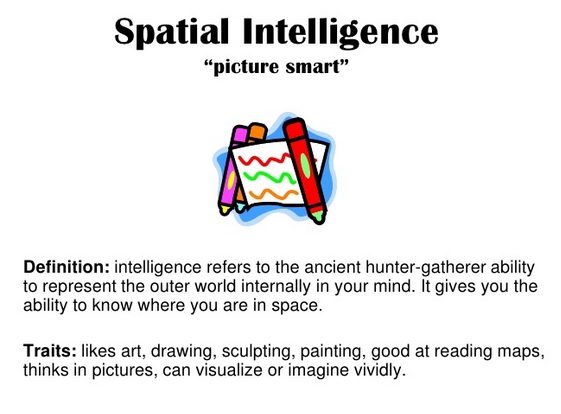
Spatial intelligence is the capacity to perceive, comprehend, and manipulate visual-spatial information within one’s surroundings. It encompasses skills like visualizing objects from different angles, discerning patterns, and grasping spatial relationships. Identified within Howard Gardner’s Theory of Multiple Intelligences, this ability allows individuals to navigate environments, address problems involving shapes or layouts, and conceptualize them in three dimensions. Spatial intelligence naturally emerges in young children through child-led play, such as stacking blocks, doodling, or piecing together puzzles.
Spatial intelligence reveals itself in early childhood as children explore their world through self-directed discovery. Research shows that infants as young as three months track moving objects with their eyes, while toddlers hone this skill by freely experimenting with stacking, sorting, or nesting items during play. This development unfolds organically as children follow their curiosity rather than requiring structured intervention. Parents and educators might notice a child’s spatial strengths in their ability to recall where toys are hidden, trace a path through a room, or tinker with objects intuitively.
The importance of spatial intelligence reaches far beyond playtime, laying a foundation for success in mathematics, science, and engineering. Studies, including findings from the National Science Foundation, link strong spatial skills to achievement in STEM fields, where tasks like interpreting graphs or understanding geometry depend on mental manipulation of space. Child-led exploration—whether building a tower or navigating an obstacle course—naturally cultivates these abilities, preparing children for academic challenges without formal lessons.
Children nurture their spatial intelligence best when given the freedom to play and explore on their own terms. Everyday moments, like constructing forts from couch cushions, exploring new spaces, or arranging toys in unique patterns, allow them to sharpen their spatial awareness instinctively. Unlike adult-driven tasks, this organic process taps into a child’s innate drive to experiment and create, fostering both spatial skills and a sense of independence and joy in learning.
Spatial intelligence is a dynamic ability that flourishes through a child’s self-guided interactions with their environment. While verbal or logical skills often dominate early education, spatial development thrives quietly in the background of play. By stepping back and letting children lead—whether mapping out a pretend treasure hunt or disassembling a toy—caregivers and educators enable them to build a vital skill set for creativity, problem-solving, and long-term success.
Thoughts On This Entry?
I’d love to hear your thoughts on improving this entry and suggestions for additional glossary additions in the comments below. You can also contact me with comments or concerns.
Contribute content to Playvolution HQ
Brought to you by Explorations Early Learning
Browse Trainings

Post Author

Jeff Johnson is an early learning trainer, podcaster, and author who founded Explorations Early Learning, Playvolution HQ, and Play Haven.
Leave a Reply