
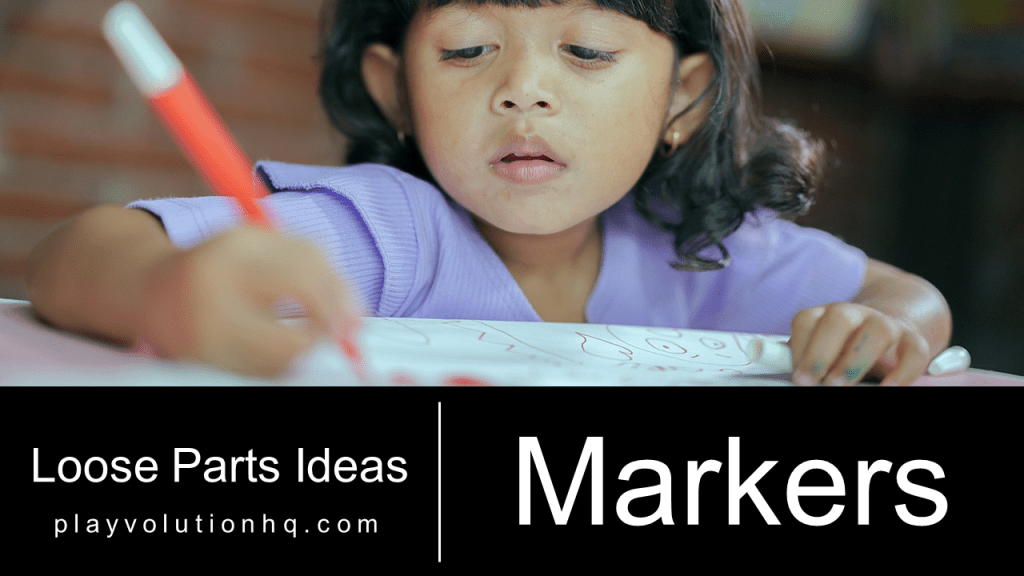
Markers offer unending creative possibilities as loose parts in children’s play environments. Whether provided as part of an art station or incorporated into imaginative play scenarios, markers inspire children to express themselves through colorful drawings, doodles, and designs.
Drawing with markers encourages fine motor skills development as children manipulate the markers to create lines, shapes, and patterns, fostering hand-eye coordination and precision.
Markers provide a tangible outlet for children’s imagination and creativity, promoting open-ended exploration and imaginative self-expression as children engage in artistic activities and creative play.
Additionally, incorporating markers into play environments encourages young children to explore the communicative domain as they develop the skills needed for mastery of reading and writing.
Some may not look at markers as loose parts. They’re mistaken. According to Simon Nicholson  loose parts are variables in the environment with which people can interact. Markers surely fit into this definition.
Markers At Play






Contribute content to Playvolution HQ
Brought to you by Explorations Early Learning
Browse Trainings

Post Author

Jeff Johnson is an early learning trainer, podcaster, and author who founded Explorations Early Learning, Playvolution HQ, and Play Haven.
Leave a Reply