
Lilly and Emma walk up to me, Emma’s hand on Lilly’s shoulder. “Jeff, I have sad news. You might cry.”
“Tell me the news”
“Mama frog is dead!” says Lilly. Emma hands her a tissue. She takes it and dabs her eyes.
“That’s terrible news! She was a friend of mine. What happened?”
“There was an accident at work, and she got killeded,” replied Lilly.
“Would you like to come to a memorial service?” Emma asked.
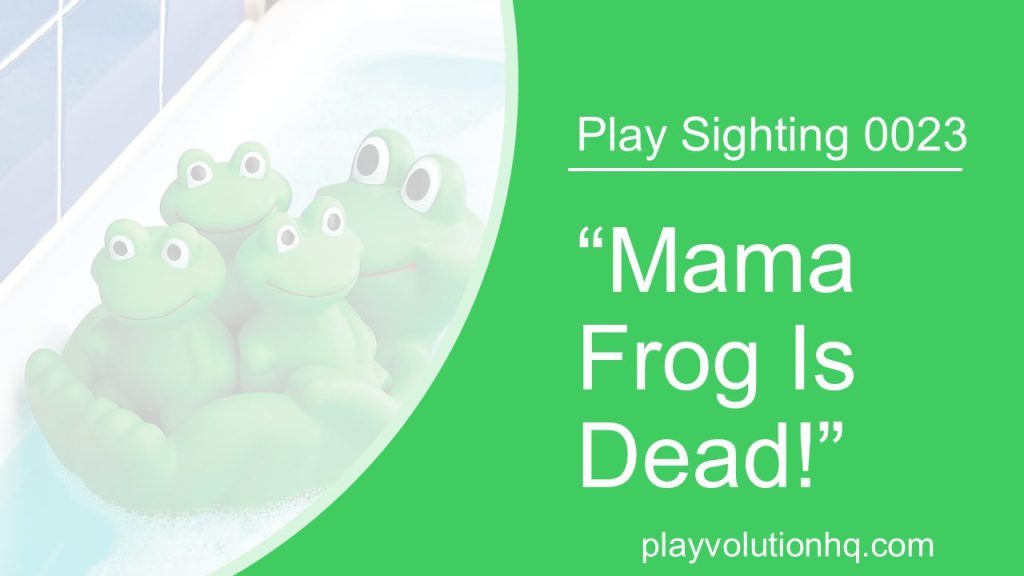
Now I knew the cause for the morning’s playroom hustle and bustle. The girls must have rearranged everything in our family child care dramatic play area. Mama frog was a plastic bath toy like the one in the above image and had been part of our playscape for years. Lilly and Emma were four-year-olds who had been around nearly as long. They arrived as infants and had older siblings in our program. I met Emma a few days after she was born and held Lilly for the first time hours after her birth. These girls had lots of experience playing together and exploring various themes. This Mama Frog Is Dead play was new.
They led me to the memorial service. A two-drawer dresser had been pulled from against a wall to the center of the room. Three rows of seating (kid chairs, milk crates, cardboard boxes) had been arranged in arches in front of it. The dresser was draped with a baby-doll blanket and topped with a bowl of small clamps and a shoebox. The shoebox was covered with a crocheted doily thingy.
As I was invited into the play, Emma brought me up to speed, “The clamps are flowers. When it is your turn, you can tell a sad story or sing a sad song about Mama Frog if you want and then put a flower on the coffin–that’s the shoebox.”
“Or you can just do the flower thing and cry,” Lilly added.
My turn came. I talked for a few minutes about my relationship with Mama Frog, starting with, “Mama Frog is dead, and I miss her very much. My heart is broken into as many pieces as we have in the LEGO tote…” After my recollections, I placed a flower.
Eventually, all the seats were filled with mourning humans, stuffed animals, plastic dinosaurs, Barbies, and other toys.
“Mama Frog Is Dead!” Wrap Up
After the funeral, we rest the play stage for another round of Mama Frog Is Dead Play. And then we did it a third time. I was biting my tongue through it all, trying not to stay in character. I wanted to laugh because the funeral they staged was so melodramatic, sweetly moving, and moving. I was almost crying because I knew the reason for this play scenario.
Play is in the child, not the toy. It grows from the players’ knowledge, thoughts, curiosity, and experiences. The Mama Frog Is Dead play was 100% Lilly’s creation. A few weeks prior, her Dad’s best friend was killed in an industrial accident at work. She’d seen her Daddy cry for the first time, went to her first memorial service, and saw her first flowers placed on a coffin. She’d heard sad stories and sad songs.
The Mama Frog Is Dead play was an effort to make sense of it all, to process her feelings, and to continue mourning.
All too often, death play, and other play that’s uncomfortable for adults, is shut down by adults. “We don’t play like that here.” That’s a mistake. Play is therapeutic. Play therapy is a thing for a reason. Children are constantly inoculating themselves with tiny doses of play therapy as they attempt to sort out their lived experiences. Parents and professional caregivers should support those efforts instead of halting them.
Contribute content to Playvolution HQ
Brought to you by Explorations Early Learning
Browse Trainings


Post Author

Jeff Johnson is an early learning trainer, podcaster, and author who founded Explorations Early Learning, Playvolution HQ, and Play Haven.
Leave a Reply