
Table of Contents
Keeping weapons play safe has been on my mind since seeing a small study relating to gun safety has been in the news. In short, researchers sorted 226 kids between 8 and 12 years old into two groups. “One group saw a one-minute video on gun safety conducted by the police chief at Ohio State University; the other group saw a similar video on car safety.“
A week later, they were brought back to the lab. Then two at a time, “kids within each group also watched clips from a PG-rated violent movie with or without guns digitally edited out. According to Bushman, the film clips were intended to act as a “trigger,” while also testing the researchers’ hypothesis that movies with guns could be a “ risk factor” that makes kids more “aggressive” around firearms.”
The kids were then brought into another lab space, again in pairs, with lots of games and toys–and two real-but-disabled 9 mm handguns hidden in a file cabinet.
96% of the kids found them within 20 minutes.
Both articles go on to share statistics and more details. For example, boys were likelier to pull the trigger and handle the guns longer. They also found that watching the video clips showing guns did not influence how they acted around the disabled firearms when they found them. Kids who reported taking a gun safety course, living in homes with guns, or disliking firearms held the real guns and pulled the triggers less frequently.
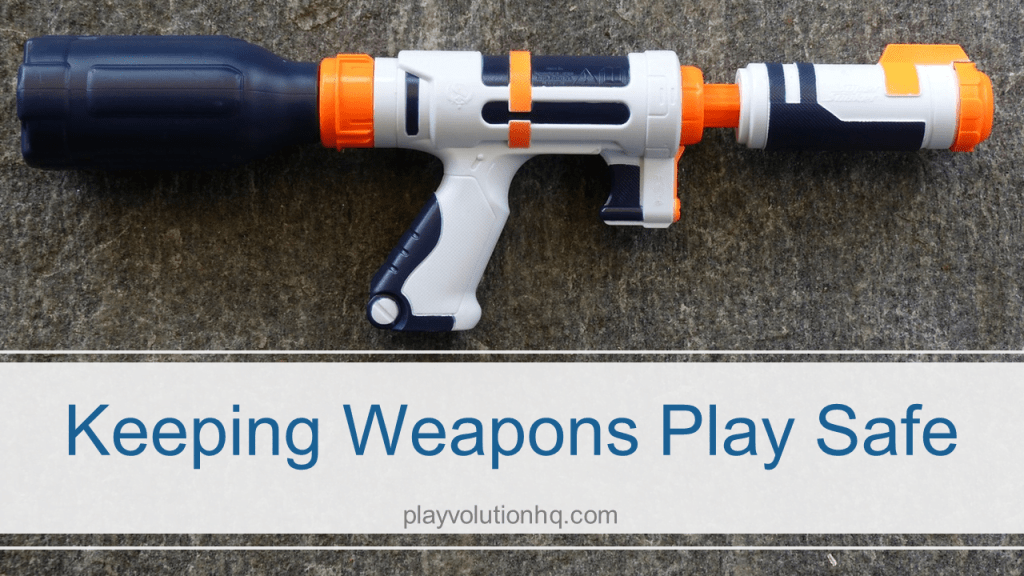
Keeping Weapons Play Safe
This small study serves as a reminder that early learning settings that support weapons play should also promote gun safety. Weapons play in a well-supervised and thoughtful play environment is pretty safe. Mainly because the weapons are not real. The danger arises when curious kids stumble across real weapons in other settings.
Keeping weapons play safe means our hazard mitigation efforts must reach beyond our classrooms’ confines. This doesn’t have to be complicated or time-consuming. It can be as simple as chatting with kids about what to do if they come across a real firearm, including a blurb about gun safety in your parent handbook, and periodically reminding parents about the importance of gun safety.
The second of the articles quoted above ends with this from one of the researchers, “If you own a gun, that’s your right – but lock it up. Unload your gun, put it in a lockbox and store the ammunition separately. Because kids are very curious, and adults drastically underestimate children’s ability to find firearms.” Reinforcing that simple message to families should be part of every early learning setting’s messaging to parents, whether they are advocates of supporting weapons play or not. Just because your setting does not allow weapons play does not mean you do not have a role to play in keeping weapons play safe.
Why Support Weapons Play?
Weapons play is a type of Power Play that provides opportunities for children to play strong, capable, in-control characters. Such play promotes a wide range of learning. It is also a type of play many children are drawn to–often due to their exposure to weapons in movies, video games, and other media. Here are links to more information on the topic:
- Power Play
- Supporting School Readiness With Power Play
- Supporting Weapons Play The Renegade Rules Way
- Take the Toys from the Boys? An Examination of the Genisis of Policy and the Appropriateness of Adult Perspectives in the Area of War, Weapon and Superhero Play
- Children Need Gun Play
- MY TODDLER LOVES GUN PLAY — HERE’S WHY I’M FINALLY LETTING IT GO
- 12 Innocuous Household Items My Son Has Turned Into Weapons
- Weapon Play in Early Childhood: How to be Developmentally Appropriate and Responsive to Current Events
- Should nurseries bite the bullet and stop banning children from playing with guns?
- Stop Tolerating Zero Tolerance
- Children Need Gun Play
- Zero-tolerance stupidity at school
Contribute content to Playvolution HQ
Brought to you by Explorations Early Learning
Browse Trainings

Post Author

Jeff Johnson is an early learning trainer, podcaster, and author who founded Explorations Early Learning, Playvolution HQ, and Play Haven.
Leave a Reply