
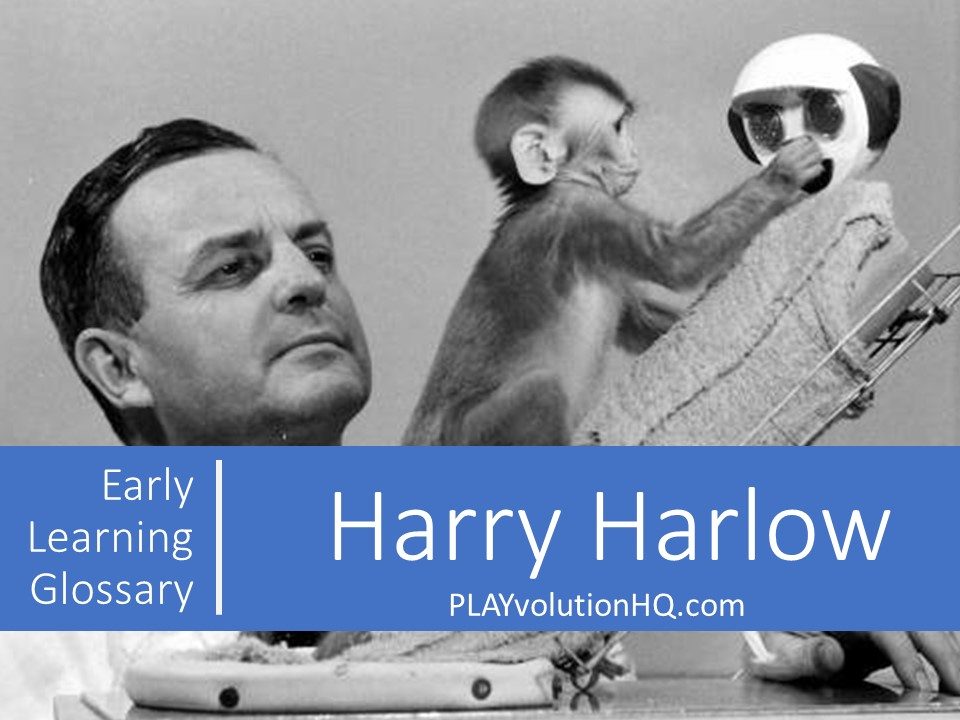
About Harry Harlow
Harry Harlow (1905-1981) was an American psychologist who studied social behavior of monkeys and applied his findings to human behavior and development. His work that is most applicable to the field of early learning involves the attachment behavior of rhesus monkeys “which are more mature than humans at birth, but like human babies show a range of emotions and require nursing to live.” (newworldencyclopedia.org)
Harlow took newborn monkeys from their mothers and gave them to surrogates. These surrogates varied, with some being made of only wire, while others were covered in cloth. Other variations had faces or could offer the newborns milk. Harlow learned that monkeys preferred cuddling with the cloth-covered surrogates to the wire “mothers,” even if the wire ones had food. However, these monkeys were not as well-adjusted as those raised by live mothers and had other young monkeys for playmates.
Harry Harlow’s work is controversial (many of the monkeys showed severe reactions to their treatment, including self-harm and antisocial behaviors, which followed them throughout their lives). Still, it did demonstrate that maternal bonds were built on touch, not feeding alone.
This attachment theory can be applied to human children and was a foundation for the science of touch that has emerged.
Additional Resources:
- Recorded interview with Harlow as he describes his experiments
- Video overview of Harlow’s experiments and their implications regarding attachment and morality
Contribute content to Playvolution HQ
Brought to you by Explorations Early Learning
Thoughts On This Entry?
I’d love to hear your thoughts on improving this entry and suggestions for additional glossary additions in the comments below. You can also contact me with comments or concerns.
Browse Trainings

Post Author

Josie is an early childhood educator turned children’s librarian from Kansas City, MO. When she’s not promoting play and early literacy, she loves to spend time with her family and travel. During her rare moments of free time, you can find Josie curled up with a cat and a good book. Feel free to reach out to her with early literacy questions or ask for book recommendations.
Leave a Reply