
Requirements
- A minimum of 2 people required for an ‘official’ game. More people is more fun–unless the player would prefer to play alone, in which case solo-hopscotch is perfectly acceptable.
- A hopscotch court (usually painted on a surface, drawn with chalk, or carved into the dirt with a stick)
- Markers (stones, coins, short sticks, etc)
Objective
To be the first player to finish one full course for each numbered square without missing a square, stepping on a line, or losing balance.
Play
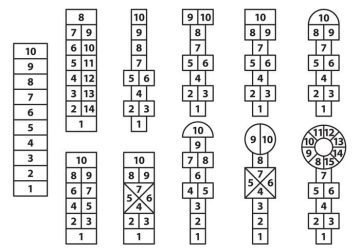
The first player tosses the marker into the number one square. It must land in the square without bouncing out or touching a line. The player then hops the course, skipping the square that contains the marker. Single squares are hopped with one foot. For side-by-side squares, two feet are used–one foot in each square. After the course is completed, the player continues their turn, tossing the marker in the number 2 square and completing the course. The turn continues until the player completes the entire course or gets out. The player is out if they:
- Miss a square with their marker
- Step on a line while hopping
- Lose balance while hopping
After the first player completes the course successfully or gets out, the second player takes their turn. An out player leaves their marker in place so they know where to begin their next turn.
Variations
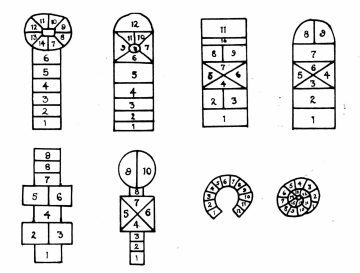
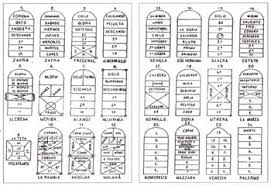
- Try different hopscotch court designs.
- Add a time element (for example, the player finishing the course the fastest wins).
- Hop backwards.
- Kick the marker from space to space instead of tossing it.
Notes
Hopscotch is known by many names, including Potsy, Laylay, Escargot, Puz, Himmel und Hölle, kith- kith, and Ekhat-Dukhat.
(Share variations or alternate rules we should include in the comments.)
Post Author

Jeff Johnson is an early learning trainer, podcaster, and author who founded Explorations Early Learning, Playvolution HQ, and Play Haven.