

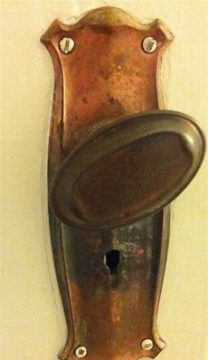
Although kids are often scolded for messing with them, doorknobs are interesting and interactive loose parts. They can spark a wide range of play and exploration. These familiar fixtures offer opportunities for dramatic play, practicing real-world activities, STEM exploration, The development of physical skills, and more.
For example, gripping and turning a doorknob to manipulate the mechanism engages children’s proprioceptive systems, fine motor skills, hand-eye coordination, grip strength, and introduce concepts like spatial awareness and cause-and-effect relationships.
As children experiment with the function of doorknobs, they gain understanding of how their actions influence the door’s movement. This hands-on exploration encourages problem-solving and critical thinking.
Doorknob play is also a chance for children to practice being careful and offers an opportunity to hone social skills. While we may not want kids playing with doorknobs all the time, opportunities to explore them are valuable.
Doorknobs At Play










Contribute content to Playvolution HQ
Brought to you by Explorations Early Learning
Browse Trainings

Post Author

Jeff Johnson is an early learning trainer, podcaster, and author who founded Explorations Early Learning, Playvolution HQ, and Play Haven.
Leave a Reply