
Table of Contents
Overview
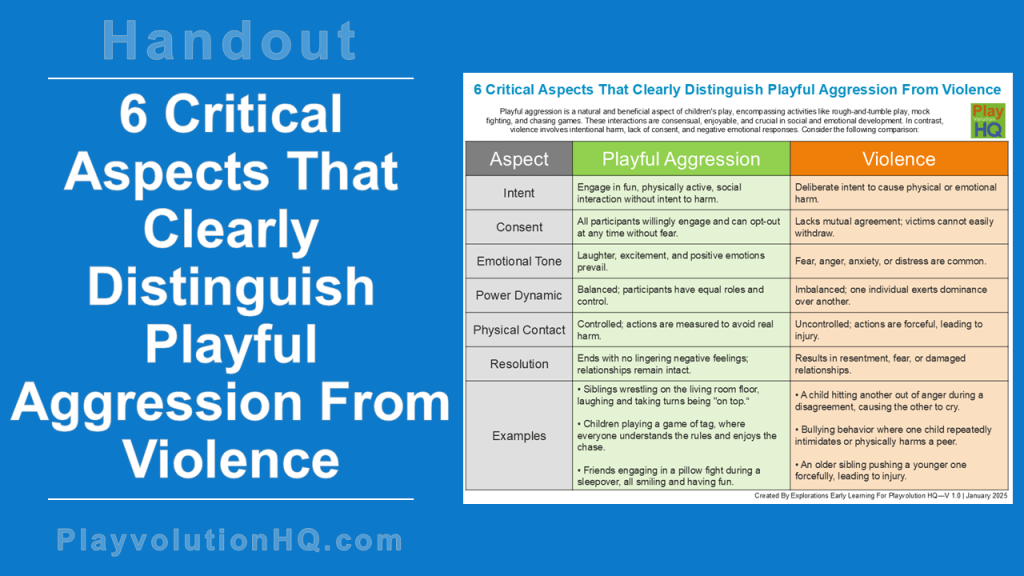
Distinguishing playful aggression from violence is essential for understanding children’s interactions and fostering healthy development. This handout highlights six critical aspects that differentiate these behaviors, offering caregivers and parents a tool to recognize and support developmentally appropriate play while keeping kids safe from violence. Playful aggression encompasses forms of power play, including rough-and-tumble play, mock fighting, and chasing games, all characterized by consent, enjoyment, and balanced power dynamics. These forms of play help children develop social skills, emotional regulation, physical coordination, and more.
In contrast, violence involves intentional harm, a lack of mutual agreement, and negative emotional outcomes. By focusing on intent, consent, emotional tone, power dynamics, physical control, and resolution, this resource supports responsible adults in creating environments where children can safely explore boundaries, build relationships, grow through play, and identify when play shifts into harmful territory.
Download The Distinguish Playful Aggression From Violence Handout
Here’s the handout PDF to download, share, or print as you see fit:
Related Posts
Contribute content to Playvolution HQ
Brought to you by Explorations Early Learning
Browse Trainings

Post Author

Jeff Johnson is an early learning trainer, podcaster, and author who founded Explorations Early Learning, Playvolution HQ, and Play Haven.
Leave a Reply