
Table of Contents
Permission-driven environments become the default when adults fret about losing control, feel a need to curb active curiosity and energy, and lean into safetyism.
In the bustle of early learning settings, it’s easy to fall into these traps and over-manage children’s activities.
We’ve all been there as parents or professional caregivers—hovering like helicopters, issuing constant directives, banning everything that feels the least bit risky, and expecting kids to ask before doing just about anything.
But what if this well-intentioned control is actually holding kids back? Here at Playvolution HQ, we’re all about championing play that’s free, risky, and child-led. Let’s dive into the pitfalls of permission-driven environments and why it’s time to loosen the reins.
What We Mean by Permission-Driven
Picture this: An excited, almost-three-year-old spots a playground puddle during outdoor time and instinctively wants to splash in it. But instead of diving in, she freezes and looks to a nearby adult for approval. Her excitement drains as she awaits a response.
Or this: A five-year-old artist decides the masterpiece headed for the refrigerator needs a few strokes of red paint—but he was only issued containers of blue, yellow, and green. Getting red means tracking down an adult, asking for the paint, explaining why he needs it, and (maybe) returning to his project with the desired color.
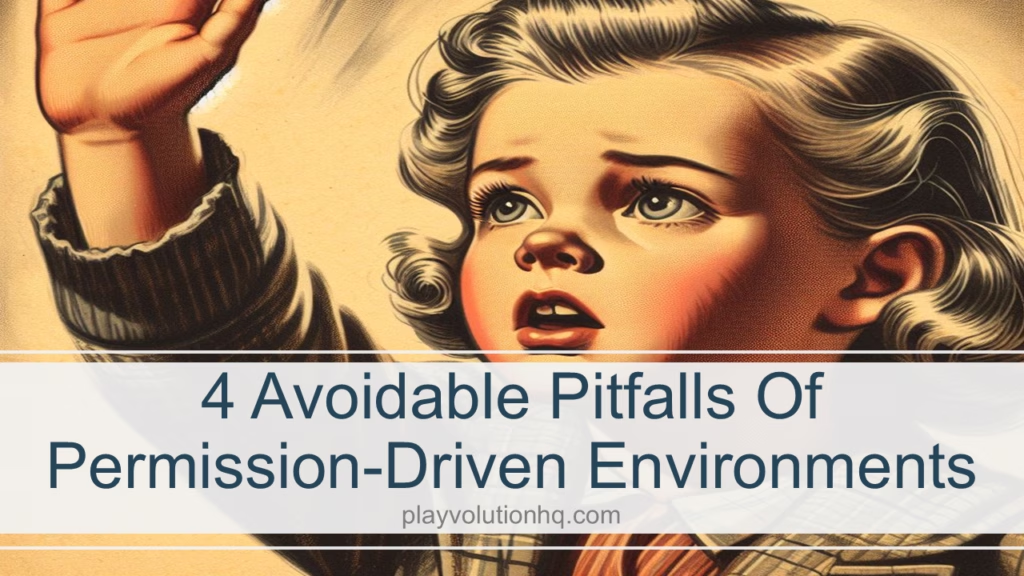
Permission-driven environments are those where children must seek adult approval for nearly every action—from choosing materials to exploring new activities. It’s often rooted in legitimate safety concerns and a desire for structure, but in preschools and child care settings, it frequently morphs into a system that prioritizes adult control over child autonomy.

Now picture this: An environment where young artists have open access to the full rainbow of paint colors, and it’s simply assumed that puddles are for jumping in.
While clear boundaries are essential, an over-reliance on permissions creates more problems than it solves. Let’s look at four common (and totally avoidable) pitfalls of permission-driven environments:
Pitfall 1: Stifling Creativity and Problem-Solving
Kids are natural innovators. In a truly play-based setting, a simple rectangular wooden block might be a smartphone today, a slice of cheese tomorrow, a brick of gold the next day, become The Batman a few days later, and serve as a robot control clicker by the middle of next week. In between all that, it might even get used for… building.
But when every wild idea requires a green light from an adult, that magical spark dims fast. Research from thinkers like Peter Gray, a leading champion of self-directed play, shows clearly that children learn and create best when they’re free to experiment without constant oversight.
In permission-heavy preschools and child care settings, I’ve seen little ones hesitate to mix paints, combine materials in unconventional ways, or chase a sudden inspiration—simply because they’re conditioned to wait for adult approval first.
The result? Diminished creativity, fewer bold ideas, and an early fear of failure.
Pitfall 2: Undermining Confidence and Independence
One of the core goals in early childhood education is fostering independence—tying shoes, resolving conflicts, and making choices. Yet permission-driven setups send a subtle message: “You can’t be trusted to decide.” Over time, this erodes self-confidence.
Parents might notice this at home when a child who’s bold in free play suddenly becomes timid in structured child care. Ellen Sandseter’s work on risky play highlights how allowing kids to navigate challenges builds resilience.
In contrast, constant permission-asking can lead to dependency, where children second-guess themselves even in simple tasks like selecting a snack or joining a game.
Pitfall 3: Limiting Social and Emotional Growth
Play is where kids hash out social dynamics—sharing, negotiating, disagreeing, even dealing with the occasional tussle.
In permission-driven environments, adults often step in too quickly, dictating who plays with what or how conflicts unfold. This interrupts the natural flow of rough-and-tumble play or superhero scenarios that teach empathy and boundaries.
As Heather Shumaker argues in her renegade rules for raising competent and compassionate kids (like in It’s OK Not to Share), over-controlled settings rob children of chances to practice conflict mediation—speaking up, reading emotions, and resolving issues themselves.
For child care providers and parents, this means missed opportunities for kids to practice real-world skills, leading to groups that are compliant but not truly collaborative or resilient.
Pitfall 4: Increasing Stress for Everyone Involved
Let’s not forget the adults in the room. Teachers and caregivers in permission-heavy programs often end up as constant gatekeepers—fielding endless requests, enforcing rules that can feel arbitrary, and watching burnout creep in fast.
Back before I transitioned away from permission-driven programming, I often felt more like a “Play Cop” than an educator. So much time and energy went into issuing “citations,” intervening in every little thing, and hovering over activities I thought needed my attention. It was exhausting—and it followed me home, where I brought those same practices to my own two kids.
Keeping play at the heart of early childhood isn’t just good for the kids; it’s part of your self-care plan as a caregiver or parent. It means trading micromanaging for joyful observation. When kids have real freedom to explore within safe, clear limits, everyone breathes easier—including you.
Shifting Toward Freedom in Play
So, what’s the alternative? It’s not chaos—it’s thoughtful design.
Start by creating play environments where “yes” is the default: spaces filled with abundant and diverse loose parts, plenty of options, unstructured time, and room to move. Set clear, broad boundaries (like no hurting people or the space), then trust the process.
Next, shift from risk prevention to hazard mitigation. Children need to take physical, social, emotional, and intellectual risks to learn and grow. The safest, most effective approach is to help them spot and manage real hazards—teaching them to predict or recognize potential dangers—so they can engage in informed, beneficial risk-taking.
Finally, step back. Observe the play, notice the learning unfolding, adjust the environment as needed, and offer support only when it’s truly requested or required.
If a full shift feels overwhelming, start small—maybe with a daily “free choice” hour where kids truly lead the way. This site is packed with resources (handouts, articles, and ideas) to support your efforts every step of the way.
In the end, permission-driven environments might feel safe, but they often clip the wings of young explorers. By embracing play that’s child-initiated and adult-supported (not adult-directed), we raise confident, creative, resilient kids who are ready for whatever the world throws at them.
What’s one small change you can make today in your preschool, child care, or home routine? Drop it in the comments—we’d love to hear your thoughts and keep the conversation rolling.
Contribute content to Playvolution HQ
Brought to you by Explorations Early Learning
Browse Trainings

Post Author

Jeff Johnson is an early learning trainer, podcaster, and author who founded Explorations Early Learning, Playvolution HQ, and Play Haven.
Leave a Reply