
Revised | Originally Published: July 3, 2021 @ 4:24 pm
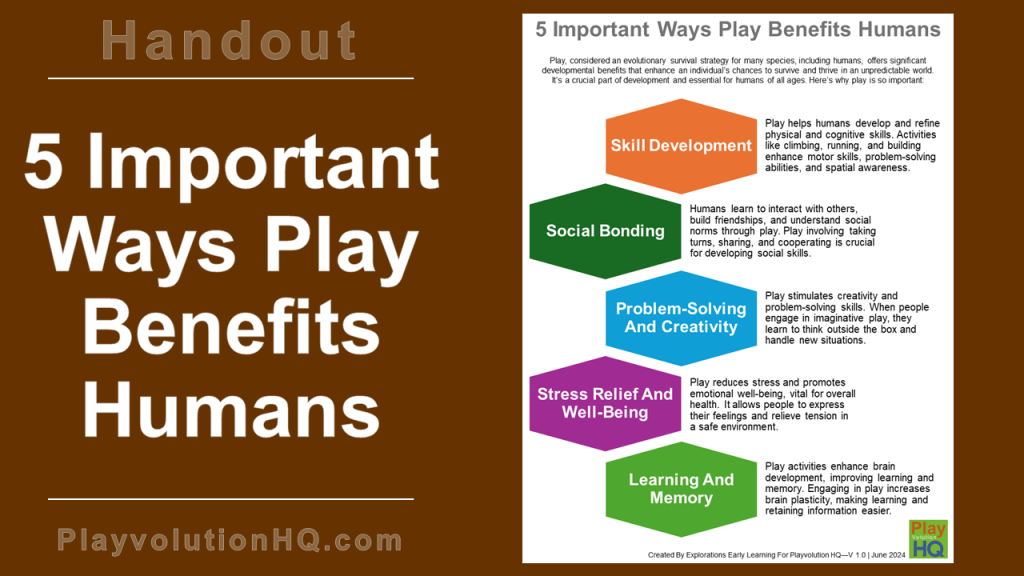
Play benefits humans and other animals in many ways. It is considered an evolutionary survival strategy that offers significant developmental benefits that enhance an individual’s chances to survive and thrive in an unpredictable world. You might say that we humans have a playful instinct.
Download The Ways Play Benefits Humans Handout
Download and share as you see fit:
References
Check out these sources for more information:
- Bekoff, M., & Byers, J. A. (1998). Animal Play: Evolutionary, Comparative, and Ecological Perspectives. Cambridge University Press.
- Pellegrini, A. D., & Smith, P. K. (1998). The Development of Play During Childhood: Forms and Possible Functions. Child Psychology & Psychiatry Review Volume 3, No. 2, 1998.
- Bateson, P. (2005). The Role of Play in the Evolution of Great Apes and Humans. In The Nature of Play: Great Apes and Humans (pp. 13-24). Guilford Press.
- Burghardt, G. M. (2005). The Genesis of Animal Play: Testing the Limits. MIT Press.
- Pellis, S. M., & Pellis, V. C. (2010). The Playful Brain: Venturing to the Limits of Neuroscience. Oneworld Publications.
Related Content
Contribute content to Playvolution HQ
Brought to you by Explorations Early Learning
Browse Trainings

Post Author

Jeff Johnson is an early learning trainer, podcaster, and author who founded Explorations Early Learning, Playvolution HQ, and Play Haven.
Leave a Reply