
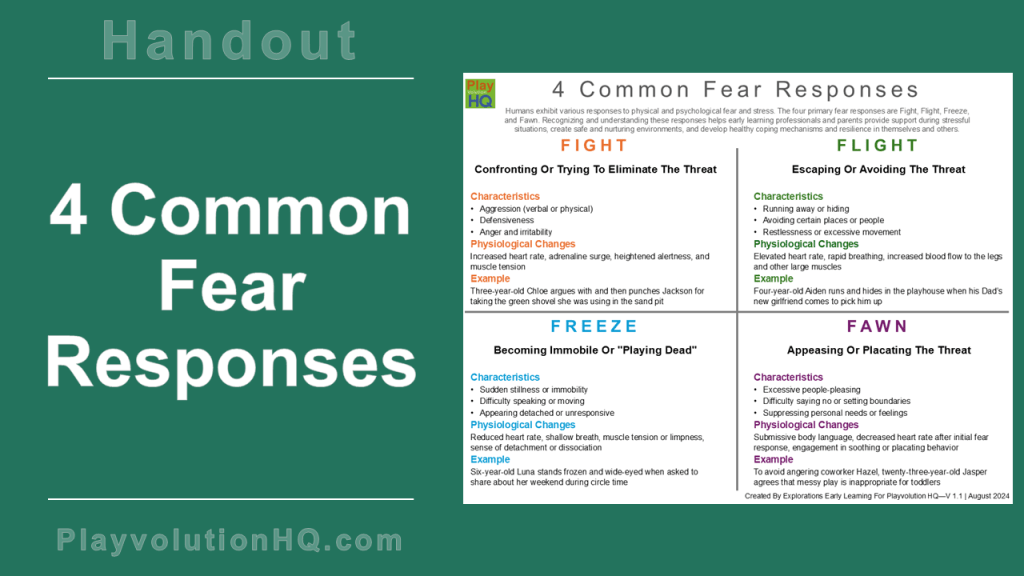
This handout explains 4 common fear responses. Understanding these responses can come in handy in early learning settings. For example, when helping a new child settle into the program, supporting children in navigating developmentally appropriate risk, or helping kids learn to face fears.
When the amygdala detects a threat, it can activate several automatic fear responses designed to protect the individual. These responses are often summarized as fight, flight, freeze, and fawn.
The amygdala is a small, almond-shaped structure located deep within the brain’s temporal lobe. It is a crucial component of the limbic system, which is involved in processing emotions, memory, and survival instincts.
The concept of the “fight or flight” response was first introduced by American physiologist Walter Bradford Cannon in the early 20th century. Cannon’s work focused on how animals and humans respond to perceived threats, and he described the physiological changes that prepare the body to either confront or escape danger.
The freeze response, while not attributed to a specific individual, became more widely recognized and integrated into the understanding of trauma and stress responses over time. This concept has been discussed in various works on trauma psychology and behavioral responses to stress. The “fawn” response is a more recent addition to this set of responses, attributed to the work of therapist Pete Walker.
Download The Fear Responses Handout
Download and share as you see fit:
Contribute content to Playvolution HQ
Brought to you by Explorations Early Learning
Browse Trainings

Post Author

Jeff Johnson is an early learning trainer, podcaster, and author who founded Explorations Early Learning, Playvolution HQ, and Play Haven.
Leave a Reply